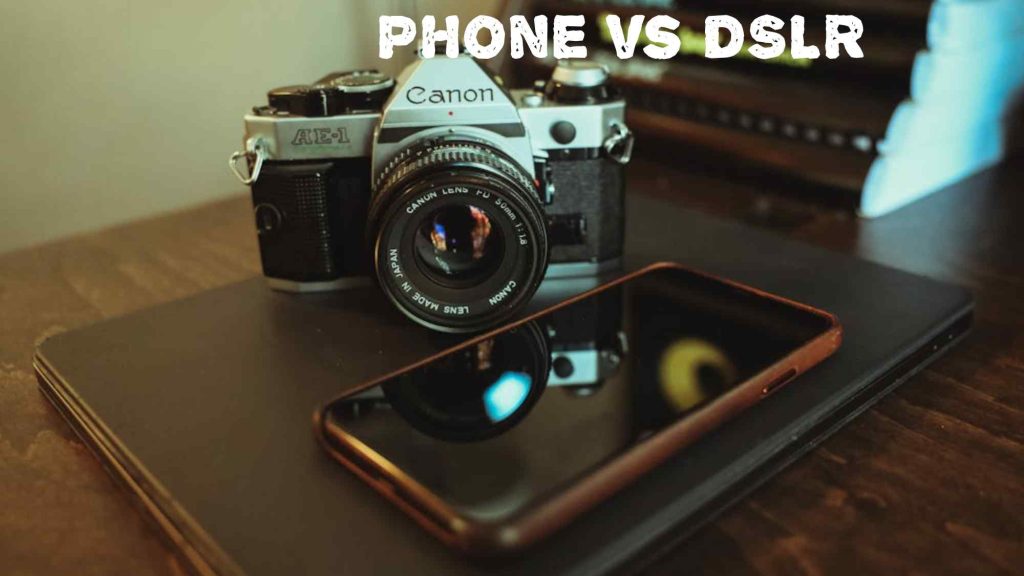
Breaking Down the Myth in Modern Photography
In a world where smartphones now come with multiple lenses, AI enhancements, and 4K video recording, the age-old photography debate is hotter than ever:
Can you really tell the difference between a photo shot on a phone and one taken with a DSLR?
Spoiler alert: The answer is more nuanced than you might think.
This post breaks down the differences between phone and DSLR photography in terms of image quality, creative control, use cases, and most importantly—how much it matters to the average viewer.
The Smartphone Photography Revolution
Smartphones have evolved from simple point-and-shoot tools into intelligent photography machines. Thanks to computational photography, your phone camera can now:
- Instantly blur backgrounds (portrait mode)
- Balance exposure across highlights and shadows (HDR)
- Enhance night scenes with stacking algorithms
- Sharpen faces while softening skin
- Apply filters and edits in seconds
Today’s flagship phones like the iPhone, Google Pixel, and Samsung Galaxy deliver images that are shockingly good—sometimes even excellent.
So… do we even need DSLRs anymore?
What a DSLR (or Mirrorless Camera) Still Does Better
While phone cameras have leveled up, DSLRs and mirrorless cameras still win in areas where hardware trumps software:
1. Sensor Size = Superior Quality
- DSLRs use much larger image sensors than phones (e.g. full-frame or APS-C).
- Larger sensors capture more light, which means better low-light performance, less noise, and more detail.
2. True Depth of Field
- Phones simulate background blur using software.
- DSLRs achieve optical bokeh using lenses with wide apertures—natural, smooth, and far more flexible.
3. Lens Variety
- DSLRs let you change lenses: macro, telephoto, wide-angle, prime, zoom.
- Each lens brings creative possibilities you simply can’t replicate on a phone.
4. Manual Control
- With a DSLR, you control shutter speed, aperture, ISO, white balance, and focus precisely.
- Phone apps offer manual modes—but with limitations.
5. Dynamic Range & Color Grading
Phone images are usually heavily processed, which limits flexibility in post-production.
DSLRs capture RAW files with more latitude for editing.
When Phones Might Be “Good Enough” — Or Even Better
Let’s be honest—there are plenty of scenarios where phones win:
🔹 Social Media Content
For platforms like Instagram, TikTok, or stories, your audience views content on small screens. The quality difference between phone and DSLR becomes nearly invisible.
🔹 Travel & Spontaneity
Phones are lightweight, always with you, and discreet. You’re more likely to catch real moments because you’re not lugging gear or changing lenses.
🔹 AI & Auto Modes
Phones intelligently enhance photos in real time—adjusting exposure, fixing skin tones, and auto-composing shots. This makes phones more user-friendly for casual photographers.
🔹 Low Barriers to Entry
No need for expensive gear, editing software, or technical knowledge. You just point, shoot, and share.
🔍 Can the Average Viewer Tell the Difference?
Let’s test a common situation:
- A beautifully composed portrait with shallow depth of field.
- One is taken with a DSLR and 50mm f/1.8 lens.
- The other with an iPhone in Portrait Mode.
On Instagram or a phone screen? Most people can’t tell.
Printed at large size or viewed on a high-res monitor? A trained eye probably will.
So here’s the reality:
The difference is noticeable—if you know where to look. But whether it matters depends on your purpose.
A Realistic Comparison: Use Case Breakdown
| Use Case | Winner | Why |
|---|---|---|
| Social Media | 📱 Phone | Fast, processed, platform-ready |
| Professional Portraits | 📸 DSLR | Better optics, natural bokeh |
| Street Photography | 📱 Phone | Stealthy and fast |
| Studio Work | 📸 DSLR | Controlled lighting, interchangeable lenses |
| Vlogging/YouTube | 📱 or 📸 | Both valid—depends on setup and sound |
| Low Light Events | 📸 DSLR | Superior sensor and ISO range |
| Everyday Moments | 📱 Phone | It’s always with you |
So… Which One Should You Use?
Use Your Phone If You:
- Want to shoot fast and share instantly
- Are focused on social media or daily documentation
- Don’t want to carry extra gear
- Prefer automation and convenience
Use a DSLR If You:
- Want to learn the art and science of photography
- Shoot professionally or sell prints
- Love creative control and post-processing
- Value top-tier image quality
Pro tip: Many pros use both—a phone for quick shots, and a DSLR for planned shoots. It’s not an either/or—it’s a toolkit.
Final Thoughts: It’s Not About the Gear. It’s About the Eye.
The truth? A skilled photographer can take a stunning photo with a $500 phone. An untrained eye can shoot a dull image with a $5,000 DSLR.
The best camera is the one you know how to use well.
Instead of obsessing over gear, focus on:
- Light
- Composition
- Timing
- Emotion
Master these, and no one will care what you shot it on.
Want More Photography Truths Like This?
Join the Photoclick community for weekly insights, challenges, and tutorials—helping you shoot smarter, not just bigger.